K. Tschährä feat. Arto Lappi – Selittämättömät hahmot
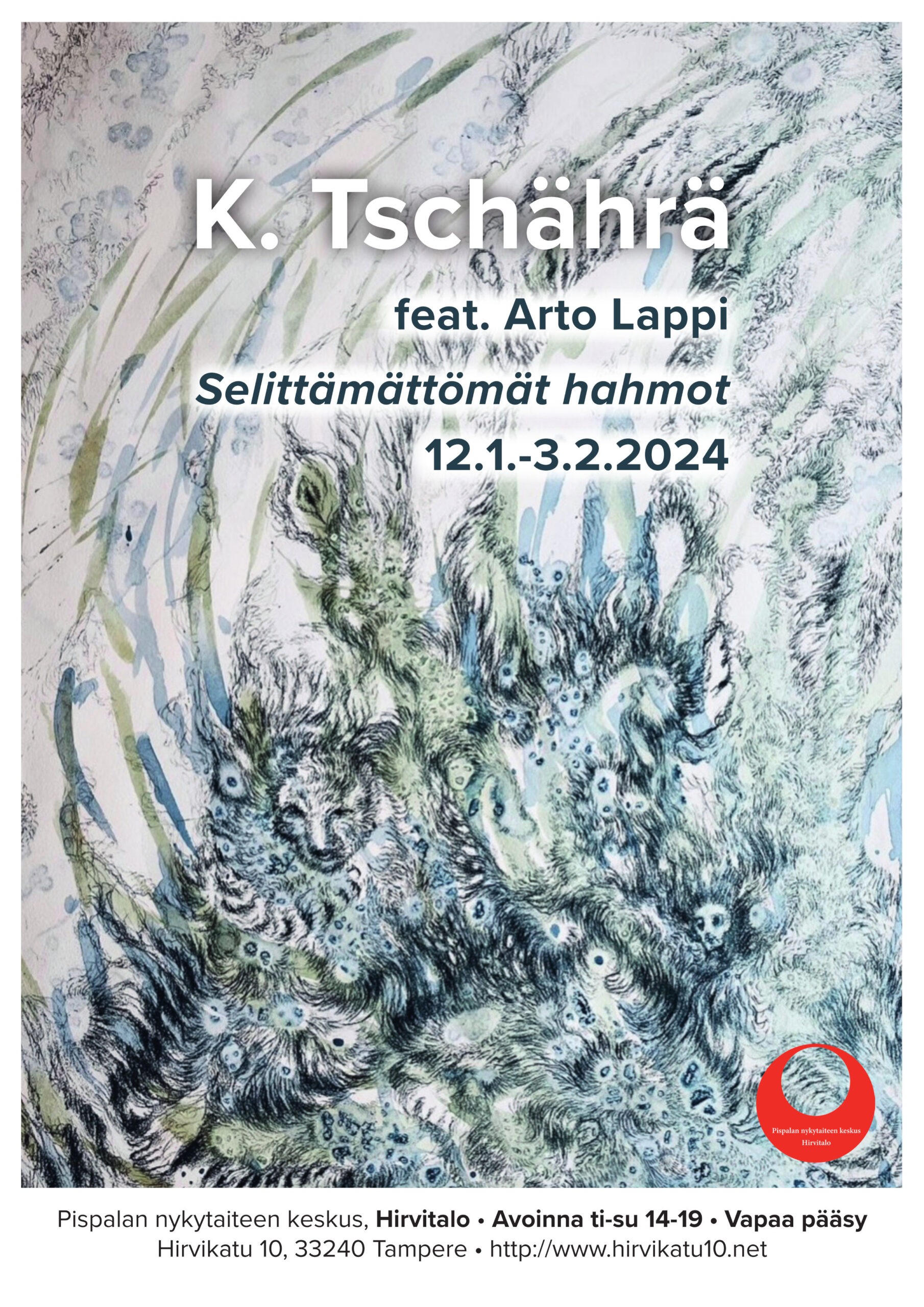
K. Tschährä feat. Arto Lappi – Selittämättömät hahmot
12.1.–3.2.2024
Pispalan nykytaiteen keskus, Hirvitalo
Hirvitalon yläkerran kahdessa huoneessa esillä oleva näyttely Selittämättömät hahmot esittelee K. Tschährän uusimpia teoksia ja Arto Lapin runoja, jotka ovat syntyneet Tschährän teoksiin.
Näyttelyn ensimmäisessä huoneessa on esillä K. Tschährän tummasävyisiä teoksia, joissa pääosassa on yksityiskohtainen piirrosjälki. Toinen huone esittelee taiteilijan maalauksellisempia ja vaaleasävyisiä teoksia. Kummassakin huoneessa on Arto Lapin runoja, jotka liittyvät esillä oleviin teoksiin. Teokset ja runot elävät omaa elämäänsä, mutta ovat symbioottisessa yhteydessä toisiinsa ja kokijan luomiin merkityksiin.
K. Tschährä työskentelee piirtämisen, maalaamisen ja videotaiteen parissa. Hän tutkii taiteensa kautta ihmismielen ja kehon tiedostamatonta ilmaisua. Pikkutarkoissa piirroksissa solujen mikroskooppinen elämä yhdistyy äärettömän universumin liikkeisiin. Fraktaalit, pisteiden täyttämät muodot ja kudelmilta näyttävät tekstuurit muodostavat orgaanisia rihmastoja ja ovat kuin hitaasti pyörivässä liikkeessä. Ihmiskasvot ja eläimet leijuvat energioiden virrassa piilokuvamaisina hahmoina.
K. Tschährän taide käsittelee luonnon ikuista kiertokulkua ja shamanismin perintöä, jossa olemassaolomme liittyy menneeseen ja tulevaan ja jossa kaikki olevaiset ovat yhteydessä toisiinsa. Rihmastot ovat kuin yhdistäviä lankoja tai impulsseja. Aika ei ole lineaarinen, vaan eri aikatasot ja tapahtumat ovat olemassa yhtä aikaa ja kerroksittain.
Tschährä on taiteilijanimi, se on taiteilijan suvun alkuperäinen, karjalainen sukunimi. K. Tschährä (aka Katja Villemonteix) asuu ja työskentelee lapsuudenkodissaan Pispalassa. Hän hyödyntää taiteessaan kehon automaatiota ja hänen taiteensa voi luokitella ns. visionääritaiteeseen.
“Piirtäminen on minulle kuin ikiaikainen riitti, jota minun on toistettava jopa pakkomielteenomaisesti ja koneen kaltaisella tavalla. Prosessi on minulle hyvin henkilökohtainen ja intensiivinen ja tuntuu riittämättömältä yrittää avata sitä sanoin. En suunnittele teoksiani enkä tee luonnoksia, hahmot ilmestyvät oman tahtonsa mukaan. Jokaisella ns. virheellä on oma tarkoituksensa ja työ muokkaantuu syntyvän jäljen johdattamana. Koen taiteeni henkisen kodin olevan alkuperäiskansojen kuvastossa ja luolamaalauksissa.
Vaikka teokseni ovat suurelta osin abstrakteja, näen niissä luonnonmuodot ja tuulen kuviot, pilvien ja aaltojen liikkeet, lintu- ja kalaparvien muodostelmat jne. Piirtäminen antaa minulle vapaudentunteen ja sillä on vahva meditatiivinen merkitys. Työskentelen taiteilijanimellä, koska taiteeni on erillinen arkiminästäni. Tschährä-nimi liittää minut myös karjalaisen sukuni jatkumoon.”
– K. Tschährä
Arto Lappi (s. 1966) on tamperelainen runoilija, jolta on ilmestynyt 10 runokirjaa sekä kaksi toisiaan täydentävää laajempaa valikoimaa (Taivaanpohjassa laulavat valaat, 2020, Korallimieli, 2023). Hän on myös toiminut suomentajana (mm. Raymond Carver, Jack Kerouac, Anne Waldman). Laajemmalle yleisölle hän on tuttu Aamulehden Moro-lehdessä ilmestyneistä sananselityksistään, joista on myös koostettu kaksi kirjaa (Pökhölmistä päivää, Katton nääs). Hän on kirjoittanut myös keskustelukirjan “Jumalaton pappi ja kampurajalka” yhdessä zenpappi Mitra Virtaperkon kanssa.
“Runoni näyttelyyn syntyivät viime vuoden aikana useassa osassa, vuorovaikutuksessa Katjan teoksiin. Tavanomainen tapa istua alas ja kirjoittaa ei toiminut. Kuvalliselle oli annettava aikaa resonoida. Tietty sarjallisuus on osoittautunut aiemmassa tuotannossani toimivaksi, ja hämmästelin kuinka yhtenäinen kokonaisuus runoista tuli. Samalla ne eivät olisi voineet syntyä ilman Katjan töiden myötävaikutusta.
Jokainen teos ja runo on samalla sekä kysymys että vastaus. Ja kaksoiskysymys: Kuka olet? Kuka olen? Emme tiedä mistä taide tulee, minne se menee. Jonnekin katsojan silmien takaiseen avaruuteen, jossa se alkaa elää omaa elämäänsä ja toivon mukaan synnyttää uusia avaruuksia.
Yksi taiteen tehtävistä on kokemisen hetki, joka vie ihmetyksen ääreen. Olla yhtä aikaa yritys ja perilläolo, tehdä kysymyksestä ja vastauksesta tarpeeton. Itse olen valinnut runouden juuri ihmetyksen tähden. Jos tietäisin etukäteen mitä kirjoitan, olisi turha kirjoittaa.”
– Arto Lappi
K. Tschährä feat. Arto Lappi – Unexplained Figures
12.1.–3.2.2024
Pispala Center for Contemporary Art, Hirvitalo
The exhibition Unexplained Figures in two rooms on the upper floor of the Hirvitalo presents K. Tschährä’s latest works and Arto Lappi’s poems, which were born from Tschährä’s works.
In the first room of the exhibition, K. Tschährä’s dark-toned works are displayed, the main part is a detailed drawing. The second room presents the artist’s more painterly and light-toned works. Both rooms have poems by Arto Lappi that are related to the exhibited works. The works and poems live their own lives, but are symbiotically connected to each other and to the meanings created by the experiencer.
K. Tschährä works with drawing, painting and video art. Through her art, she explores the unconscious expression of the human mind and body. In the detailed drawings, the microscopic life of cells is combined with the movements of the infinite universe. Fractals, shapes filled with dots and textures that look like weaves form organic tendrils are like in a slowly rotating movement. Human faces and animals float in the flow of energies as hidden image-like figures. K. Tschährä’s art deals with the eternal cycle of nature and the legacy of shamanism, where our existence is connected to the past and the future and where all things are interconnected. Mycelia are like connecting threads or impulses. Time is not linear, but different time levels and events exist simultaneously and in layers.
Tschährä is an artist name, but it is the original of the artist’s family, a Karelian surname. K. Tschährä (aka Katja Villemonteix) lives and works in her childhood home in Pispala. She uses body automation in her art and her art can be classified as so-called visionary art.
“Drawing is like an ancient rite for me, which I have to repeat even obsessively and in a machine-like way. The process is very personal and intense for me and it seems insufficient to try to open it with words. I don’t plan my works nor make sketches, the characters appear according to their own will. Each so-called mistake has its own purpose and the work is modified guided by the resulting trace. I feel that the spiritual home of my art is in the imagery of indigenous peoples and cave paintings.
Although my works are largely abstract, in them I see natural forms and patterns of wind, movements of clouds and waves, formations of flocks and fish schools, etc. Drawing gives me a sense of freedom and has a strong meditative meaning. I work under an artist name because my art is separate from my everyday self. The name Tschährä also connects me to the continuity of my Karelian family.”
– K. Tschährä
Arto Lappi (b. 1966) is a poet from Tampere, who has published 10 books of poetry and two larger selections that complement each other (Taivaanpohjassa laulavat valaat, 2020, Korallimieli, 2023). He has also worked as a Finnish translator (eg Raymond Carver, Jack Kerouac, Anne Waldman). He is known to a wider audience for his proverbs published in Aamulehti’s Moro magazine, which have also been compiled into two books (Pökhölmista päivää, Katton nääs). He has also written the discussion book “Godless priest and kampurajalka” together with Zen priest Mitra Virtaperko.
“My poems for the exhibition were created during the last year in several parts, in interaction with Katja’s works. The usual way of sitting down and writing didn’t work. Artworks had to be given time to resonate. A certain seriality has proven to work in my previous productions, and I was amazed at how coherent the poems turned out to be. At the same time, they could not have been born without the contribution of Katja’s work.
Each work and poem is both a question and an answer. And the double question: Who are you? Who am I? We don’t know where art comes from, where it goes. Somewhere in the space behind the viewer’s eyes, where it begins to live its own life and hopefully give birth to new spaces.
One of the tasks of art is a moment of experience that leads to wonder. To be a company and knowledgeable at the same time, to make the question and the answer unnecessary. I myself have chosen poetry precisely for the sake of wonder. If I knew in advance what I was going to write, it would be pointless to write.”
– Arto Lappi